
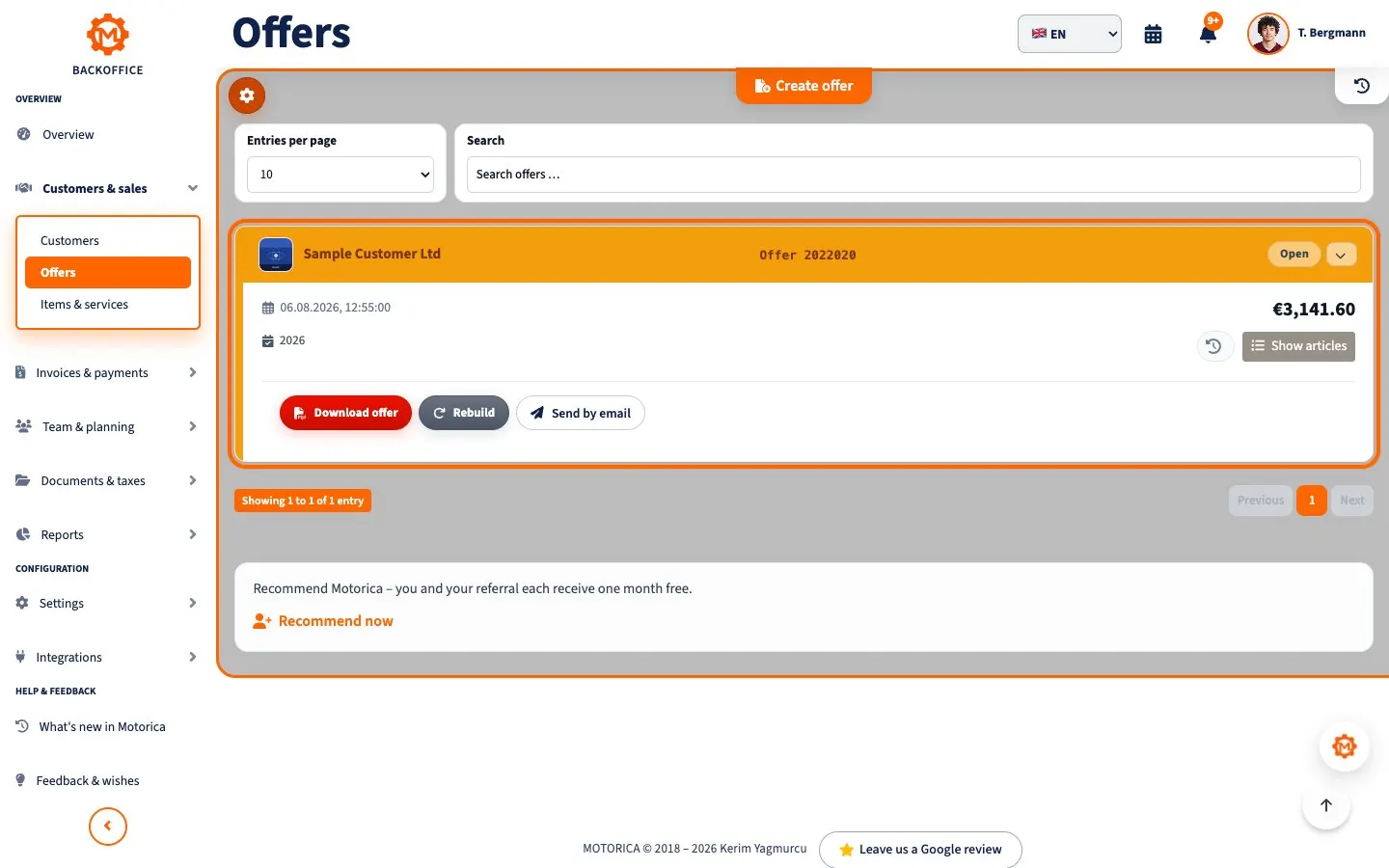
Quote and invoice at a glance
A quote proposes a service, price and terms. An invoice bills for a supply or service. A contract generally arises through matching declarations, such as an offer and its acceptance; the invoice itself is not the contract. The distinction helps German businesses document what was agreed and what was actually delivered.
What is it for?
- Quote: Proposes work and the conditions for it.
- Invoice: Bills for a supply or service.
When does it appear?
- Quote: Usually before the contract is made.
- Invoice: Often after performance; advance and progress invoices are also possible.
Is it always required?
- Quote: No. A contract can arise without a written quote.
- Invoice: The law requires one in certain cases, especially for taxable supplies to another business.
What is its legal effect?
- Quote: A sufficiently definite, binding offer can form a contract when accepted.
- Invoice: It records the billing; it does not replace the offer or acceptance.
When does a quote become binding?
Under section 145 of the German Civil Code (BGB), a sufficiently definite offer is generally binding unless the sender excludes that effect. Acceptance within the applicable period may form a contract (sections 147–148 BGB). If a customer changes a material term, such as price or scope, this is a new offer that you must accept (section 150(2) BGB). A rough estimate or expressly non-binding price list is not necessarily a binding offer.
State the scope, quantities, price, relevant VAT treatment, delivery date and any acceptance deadline clearly. Keep evidence of acceptance and later changes. An agreement can also be made by email or orally; a signed form is not a universal requirement.
What an invoice does and when to issue it
Section 14(1) of the German VAT Act (UStG) defines an invoice by its function: a document that bills for a supply or service, whatever its title. It neither replaces acceptance nor proves by itself that the customer agreed to every charge. No written quote is universally required before invoicing.
Most invoices follow the service. An agreed deposit or progress payment can be invoiced earlier. For certain taxable supplies to another business, section 14(2) UStG generally requires an invoice within six months of performance.
Required invoice details
A standard invoice under section 14(4) UStG generally needs the names and addresses of both parties; the issuer’s tax number or VAT identification number; issue date; unique sequential invoice number; description and quantity or scope of the service; supply date; net consideration; and the applicable VAT rate and amount, or the reason for exemption. Agreed discounts need to be clear. Special simplified rules apply to small-value invoices up to €250 and to invoices issued under the German VAT exemption scheme for small businesses (sections 33 and 34a UStDV). A quote number can help reconciliation but is not a general statutory invoice detail.
German e-invoices in 2026
For many transactions between businesses established in Germany, the VAT Act requires a structured e-invoice. A plain PDF is not such an e-invoice. German businesses have had to be able to receive e-invoices since 2025. For issuing them, transitional rules allow other invoice formats until the end of 2026; an issuer with prior-year turnover up to €800,000 can generally use them until the end of 2027. Paper is allowed during the transition; a simple electronic document such as a PDF requires the recipient’s consent. Exemptions and special cases, including small-business invoices, require separate consideration. These format rules concern invoices, not quotes.
Small businesses, retention and special cases
Under the German VAT exemption scheme for small businesses (Kleinunternehmerregelung) in section 19 UStG, qualifying supplies must not show VAT separately. Section 34a UStDV requires a note explaining the exemption and permits a non-structured invoice. Cross-border business can have additional invoice and VAT rules; check the transaction and both parties’ locations.
Section 14b UStG generally requires businesses to retain copies of issued invoices and invoices received for eight years, starting at the end of the year of issue. Other retention duties or pending proceedings can matter. Keep the quote, acceptance and changes as evidence of the agreed terms.
A practical workflow
- Describe the work, price, tax treatment and terms in the quote.
- Record whether the customer accepted it unchanged or proposed changes.
- Document the work performed and any agreed additions.
- Invoice the actual work or an agreed advance payment; check statutory details and format.
- Match the quote, agreement, invoice and payment in one case file.
Example: You quote €500 plus applicable VAT for a repair. The customer accepts, then agrees in writing to €80 of extra work. The invoice may include the extra work, with a clear record of the change. The invoice is not itself the agreement for that extra work.
Common questions and mistakes
Can I invoice without a quote? Yes. A written quote is not generally required, provided there is an agreed, billable transaction and the invoice complies with the rules.
Is a signed invoice an order confirmation? Its effect depends on what was actually declared and the circumstances; the invoice alone does not automatically prove agreement to every price.
Must every quote show VAT? Quotes do not have the same statutory detail list as invoices, but price and tax treatment should be clear. Consumer price-display rules may apply.
Common mistakes include treating an estimate as binding, billing unapproved changes, calling a plain PDF an e-invoice, and insisting on a VAT ID when a tax number may suffice.
Official sources and date
As of 17 September 2026. General information on German law; individual cases may need professional advice.