
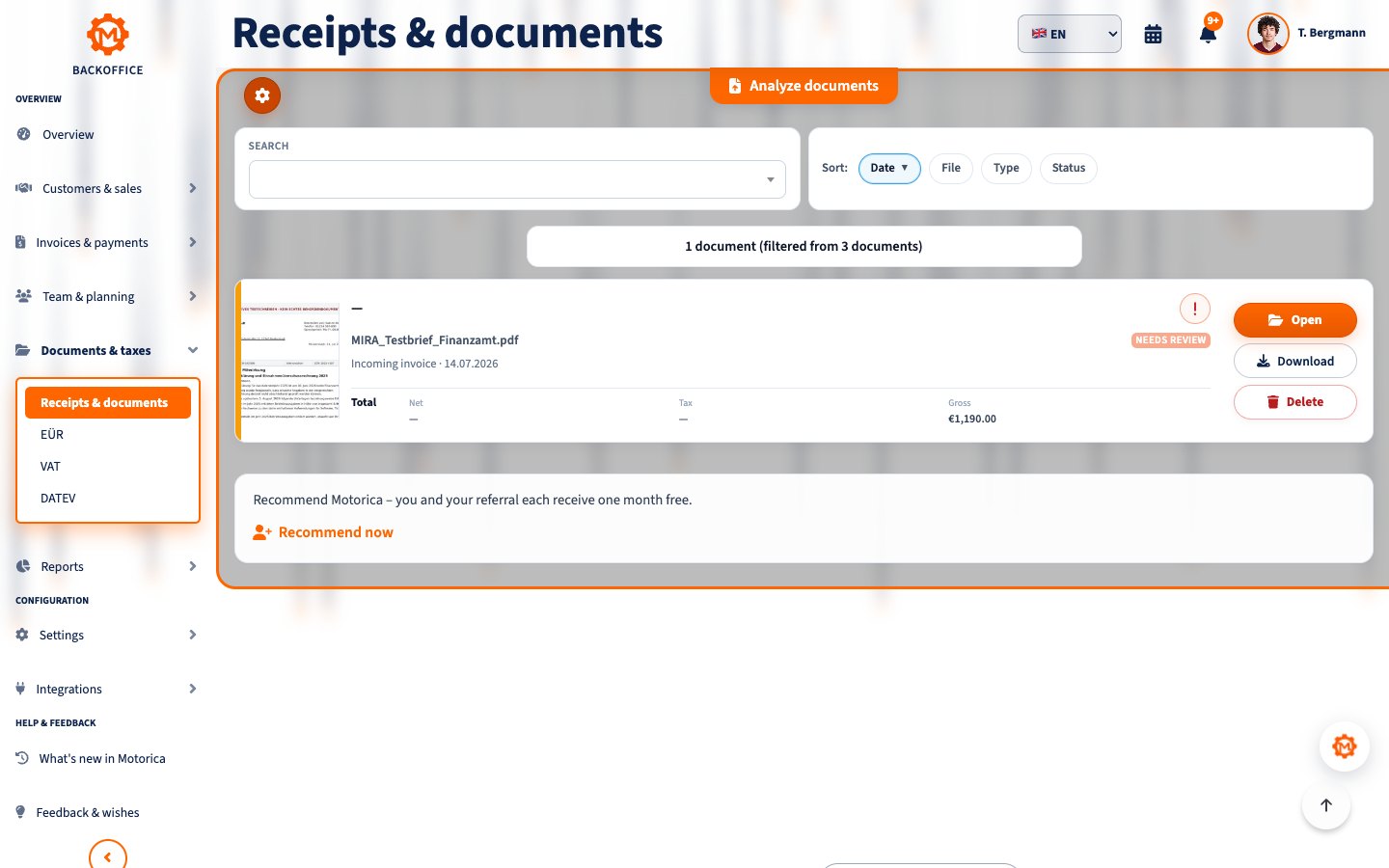
Business expenses are costs incurred due to self-employment activities. Properly documenting them allows for a clear trace of the business purpose, payment, and tax implications later. It's not about whether an expense is "typical"; even small or one-time costs can be relevant. A private expense does not become a business expense just because it is paid from a business account.
What Counts as a Business Expense?
Under section 4(4) of the German Income Tax Act (EStG), the business purpose is decisive. An expense need not be strictly necessary or especially economical, but specific deduction limits may apply. If you calculate profit using the income-surplus calculation (Einnahmenüberschussrechnung, EÜR), you compare business income with business expenses.
Document each transaction by at least what was purchased, when, from whom, at what amount, how it was paid, and for what purpose the purchase was needed in the business. Invoices or cash register receipts and payment proof should clearly match. A bank statement alone often does not explain which service was received; an invoice alone does not always prove the payment date.
Which Costs Should You Record?
The examples are not a blanket guarantee for tax deductions. What matters is actual use, evidence, and any applicable deduction limits.
Ongoing Costs and Purchased Services
- Tools and Materials: Office supplies, packaging, raw materials, and goods for customer orders. Keep invoices, purchase orders, and, if applicable, goods receipts together.
- Spaces and Ongoing Operations: Rent for a business office or warehouse, electricity, internet, phone, hosting, software subscriptions, and business insurance. For shared private and business use, a justifiable share is needed.
- External Services and Personnel: Fees, accounting, professional advice, salaries, and employer costs. Contracts, service proof, invoices, and payments complement the invoice.
- Marketing and Sales: Website, advertising, printed materials, trade show costs, and business platform fees. For hospitality and gifts, special rules apply.
Travel, Trips, and Hospitality
For a business trip, date, destination, purpose, route, and involved customer or order help in allocation. Keep tickets, hotel invoices, parking receipts, and travel expense records. A privately used vehicle and a business vehicle are taxed differently. For mixed trips, professional and private parts must be reasonably separated; personal meals are not simply deductible at the full restaurant bill.
For business hospitality, section 4(5), sentence 1, number 2 EStG generally allows a deduction of only 70% of reasonable, documented costs. Record the business occasion and attendees; for a restaurant meal, retain the restaurant invoice as well. Assess any input VAT separately. Gifts to people who are not employees have their own limits and recording requirements.
Larger Purchases and Depreciation
A laptop, a machine, or a piece of furniture used for more than a year is not automatically fully deductible in the purchase year. Record the purchase date, acquisition cost, business use, and useful life. Depending on the case, costs are spread over the useful life as depreciation (Absetzung für Abnutzung, AfA). For independently usable, depreciable movable assets, section 6(2) EStG permits immediate deduction where the acquisition cost does not exceed €800 excluding deductible input VAT. Other conditions and record-keeping duties apply. Non-deductible VAT may affect the acquisition cost.
Separate Private Shares and Special Cases
Phone, internet, or tools can be used privately as well. Document a reasonable allocation ratio, such as separate connections, usage records, or a justifiable estimate. Do not claim the private share as a business expense. For a home office, the daily allowance, and travel between home and workplace, there are specific conditions; check these separately. Private living expenses, income tax, and withdrawals do not belong in a simple list of deductible business expenses.
Even costs before business start-up can be business-related if there is a clear connection to the planned activity. Collect additional documents on the founding intention and the later business. In the absence of an external invoice, a self-issued receipt can explain the process; it does not automatically replace the required invoice nor create a VAT claim.
Business Expenses and VAT are Two Separate Checks
For a purchase invoice, first check the business purpose for income tax, and separately assess any input VAT deduction under section 15 of the German VAT Act (UStG). Business use and a properly issued invoice are among the requirements. If you apply the German VAT exemption scheme for small businesses (Kleinunternehmerregelung) under section 19 UStG, you generally cannot deduct input VAT on purchases used for those exempt sales. Business costs can still reduce your income-tax profit. Whether you show VAT on your sales invoices does not decide whether a purchase is a business expense.
Example: A software subscription used solely for business costs €119 including €19 VAT. With existing VAT deduction rights and a properly issued invoice, the costs are generally €100 as an expense and €19 as input VAT. Without VAT deduction rights, the costs are generally €119 as a business expense, unless another approach is prescribed. The example assumes full business use.
When Is the Expense Considered?
For the EÜR, the cash basis generally applies: expenses are recorded in the calendar year they are paid. Section 11 EStG contains exceptions, such as for regularly recurring payments around year-end. Depreciation and certain purchases have their own rules. Record the invoice date, service period, and payment date separately. Accrual accounting uses different period rules.
Which Documents Belong Together and How Long Do They Stay?
For each transaction, keep the original invoice or receipt, if applicable, contract or order, payment proof, and a brief explanation of the business purpose. For cash payments, the cash register receipt is particularly important. For electronic invoices, keep the structured original data set; a printout or screenshot alone is not sufficient. The BMF FAQ on electronic invoices explains the details.
Under section 147 of the German Fiscal Code (AO), accounting vouchers must generally be kept for eight years. Books and records generally require ten years; certain other documents require six. The period generally starts at the end of the calendar year in which the voucher arose and may run longer while relevant tax proceedings remain open. Digital documents must remain findable, readable, and protected against unnoticed changes. Follow the GoBD guidance of the Federal Ministry of Finance.
Practical Routine in Five Steps
- Secure Immediately: Save the invoice, cash register receipt, or electronic invoice in the original format as soon as possible after the business transaction.
- Assign: Record the supplier, date, amount, cost type, order, and business purpose. Link the payment.
- Review: Identify private shares, missing details, larger purchases, and cases with special deduction limits.
- Monthly Reconciliation: Compare documents with bank and cash movements. Request missing invoices promptly.
- Clear Open Issues: Have uncertain tax questions checked by a tax adviser before they are included in the declaration.
Checklist
- Is the business purpose of each expense clearly traceable?
- Are invoices or cash register receipts and payments clearly linked?
- Are private shares separated and justified?
- Are travel and hospitality records complete?
- Are larger purchases recorded for the AfA?
- Was the VAT separately checked from the business expense deduction?
- Are digital originals, especially electronic invoices, readable?
- Are open or unusual cases marked for tax advice?
Frequently Asked Questions
Can a bank statement suffice as a receipt?
It shows the payment, but often not the service received and its business purpose. Keep invoices, cash register receipts, or contracts if possible.
Is an expense without a VAT deduction lost?
No. A missing VAT deduction does not automatically exclude a business expense deduction for income tax. The two questions are to be checked separately.
Can I fully claim mixed-use costs?
Generally only the clearly business-related part. Special rules apply for individual cost types; document the method and check doubtful cases.
Conclusion
A good document collection is more than a folder of invoices: it shows the business purpose, the appropriate payment route, and the correct tax period for each expense. Motorica.io helps to keep documents and payments organized for this check; the legal classification remains a professional decision.
This guide explains German law generally and does not replace individual tax advice.