
The German Einnahmenüberschussrechnung (EÜR) is a simplified method of calculating taxable business profit. It is not a customer invoice, a VAT exemption or a legal form. In simple terms, business receipts minus business expenses equal the business profit or loss.
This guide explains German rules as at 16 September 2026. It provides general information and is not individual tax or legal advice.
In brief: what is an EÜR?
Under section 4(3) of the German Income Tax Act, taxpayers may calculate profit as the excess of business receipts over business expenses if they are not legally required to keep accounts and prepare regular financial statements and do not do so voluntarily.
Business receipts − business expenses = profit or loss
An EÜR therefore determines a business's taxable result for a financial year. An invoice, by contrast, documents a specific supply or service for a customer. The two must not be confused.
Who may use an EÜR?
Typical users include members of the liberal professions, traders who are not subject to commercial- or tax-law bookkeeping obligations, and certain partnerships. Companies such as a GmbH or UG (haftungsbeschränkt) generally prepare annual accounts with a balance sheet and profit-and-loss account and cannot replace these with an EÜR.
For traders, a tax bookkeeping obligation may arise where annual turnover exceeds €800,000 or annual profit exceeds €80,000. The tax office's notice stating when the obligation begins also matters. Separate commercial-law duties may apply. Section 241a HGB exempts sole traders from certain duties only where its conditions are met.
EÜR and the small-business VAT scheme are different
The EÜR concerns income tax and the method used to determine profit. The German VAT exemption scheme for small businesses (Kleinunternehmerregelung) concerns VAT. A business may therefore use an EÜR whether it applies the small-business scheme or normal VAT rules, provided it qualifies for the EÜR.
Since 2025, the small-business scheme generally requires prior-year turnover not exceeding €25,000 and current-year turnover not exceeding €100,000. These limits do not determine eligibility for an EÜR. Businesses using the scheme generally do not show VAT separately on an invoice and normally cannot deduct input VAT.
The cash-receipts and payments principle
The payment date usually determines the year:
- income is recorded when the money is received;
- expenses are recorded when the money is paid.
The invoice date alone is usually not decisive. An invoice issued in December but paid in January is generally income of the new year. Section 11 EStG contains a narrow exception for regularly recurring payments around year-end. Depreciation, long prepayments and certain assets also follow special rules.
What counts as business income?
Business income includes customer payments, advances, ancillary business revenue, proceeds from selling business assets, taxable grants and refunds, VAT collected under normal VAT rules and VAT refunds from the tax office. Private capital introduced into the business and transfers between the business's own accounts are not income. Genuine pass-through amounts collected and paid on another person's behalf are excluded under section 4(3) EStG.
What counts as a business expense?
Typical expenses include goods and materials, subcontractors, rent, energy, insurance, software, telephone, internet, wages, professional advice, training, eligible travel and vehicle costs, bank charges, deductible input VAT, VAT payments and depreciation.
Private expenditure is not deductible. For mixed use, only the substantiated business share may be claimed. Some expenses are restricted, capped or subject to special records.
VAT treatment in the EÜR
A business under normal VAT rules generally reports taxable sales net in Anlage EÜR and shows VAT collected separately as income. Deductible input VAT and VAT paid to the tax office are generally expenses; refunds are generally income.
Businesses using the Kleinunternehmerregelung normally have no input-tax deduction and therefore record the gross amounts actually received and paid. Reverse charge, intra-EU transactions and changes of VAT status should be checked with a tax adviser.
Purchases, low-value assets and depreciation
A larger purchase is not automatically deductible in full when paid. Depreciable assets used for more than one year are generally written off over their normal useful life.
Independently usable movable assets may be deducted immediately as low-value assets where the relevant cost does not exceed €800. The net amount is normally relevant where input VAT is deductible; otherwise the cost generally includes non-deductible VAT. An asset register is required in relevant cases.
Records and retention
An EÜR still requires complete, orderly records. Every transaction should be supported by an accounting document or receipt. Keep outgoing and incoming invoices, payment evidence, cash records, contracts, credit notes, cancellations, the asset register and evidence for travel or entertainment expenses.
Electronic records must remain complete, readable, available and auditable; later changes must not conceal the original. Under section 147 AO, accounting vouchers generally have an eight-year retention period. Ten- or six-year periods apply to other categories. The period generally starts at the end of the year in which the record arose.
Anlage EÜR and electronic filing
The EÜR is normally transmitted electronically using the prescribed dataset. In Mein ELSTER and compatible software the form is called Anlage EÜR. Additional schedules may be needed, including AVEÜR for assets or SZ for non-deductible interest.
The profit also flows into the appropriate tax return, such as Anlage S for self-employed professional income or Anlage G for trade income. Paper filing is permitted only if the tax office accepts an application based on undue hardship.
Simple example
A self-employed service provider receives €48,000 from customers in 2026. Paid expenses immediately deductible that year total €19,000, and depreciation is €2,000.
€48,000 − €19,000 − €2,000 = €27,000 profit
An unpaid invoice generally becomes income only when paid. A private withdrawal does not reduce profit. Cash at bank can differ from taxable profit because of capital introduced, withdrawals, loans or depreciation.
Step by step
- Confirm that the EÜR method is permitted.
- Record every business account, cash holding and payment route.
- Match each payment to supporting evidence and the correct tax category.
- Separate private items, capital introduced, withdrawals and pass-through amounts.
- Apply the correct VAT treatment.
- Review assets, low-value assets and depreciation.
- Resolve unclear entries before year-end.
- Prepare Anlage EÜR and any additional schedules.
- Reconcile the result with the tax returns and VAT records.
- Validate, transmit on time and retain the filing protocol.
Common mistakes
- Treating the EÜR as a customer invoice.
- Assuming the Kleinunternehmerregelung determines EÜR eligibility.
- Using the invoice date instead of the payment date.
- Omitting VAT movements.
- Claiming private costs.
- Expensing assets immediately when depreciation is required.
- Treating loans, capital introduced, withdrawals or internal transfers as income or expense.
- Keeping incomplete evidence or cash records.
Filing checklist
- Eligibility and possible bookkeeping duties checked
- All receipts and expenses recorded
- Payment dates reviewed
- Private and business transactions separated
- VAT, input VAT, payments and refunds reconciled
- Assets and depreciation complete
- Supporting records and cash records auditable
- Anlage EÜR and additional schedules complete
- Result reconciled with Anlage S or G
- Electronic filing documented and archived
Frequently asked questions
Is the EÜR only for small businesses under the VAT scheme?
No. The two rules address different taxes. A VAT-registered business may also use an EÜR if it is not required to keep full accounts.
Is an EÜR an invoice without VAT?
No. It is an annual profit calculation. An invoice without separately stated VAT may be issued under the Kleinunternehmerregelung, but it is not an EÜR.
Must Anlage EÜR be filed electronically?
Generally yes. Section 60(4) EStDV requires electronic transmission. The tax office may accept paper only where electronic filing would cause undue hardship.
When is income recognised?
Generally when payment is actually received. Special rules apply to regularly recurring year-end payments and certain other items.
Can I deduct a laptop immediately?
That depends on its cost, independent usability, input-VAT status and the applicable depreciation rules.
How long must records be kept?
Accounting vouchers generally eight years, certain books and records ten years, and business correspondence or other tax-relevant documents often six years. Open tax proceedings can extend practical retention.
What is the regular filing deadline?
Without a tax adviser it is generally seven months after year-end, normally 31 July of the following year. Longer regular periods apply where an authorised tax professional prepares the return. Special extensions and early requests must be checked separately.
Does Motorica support the EÜR?
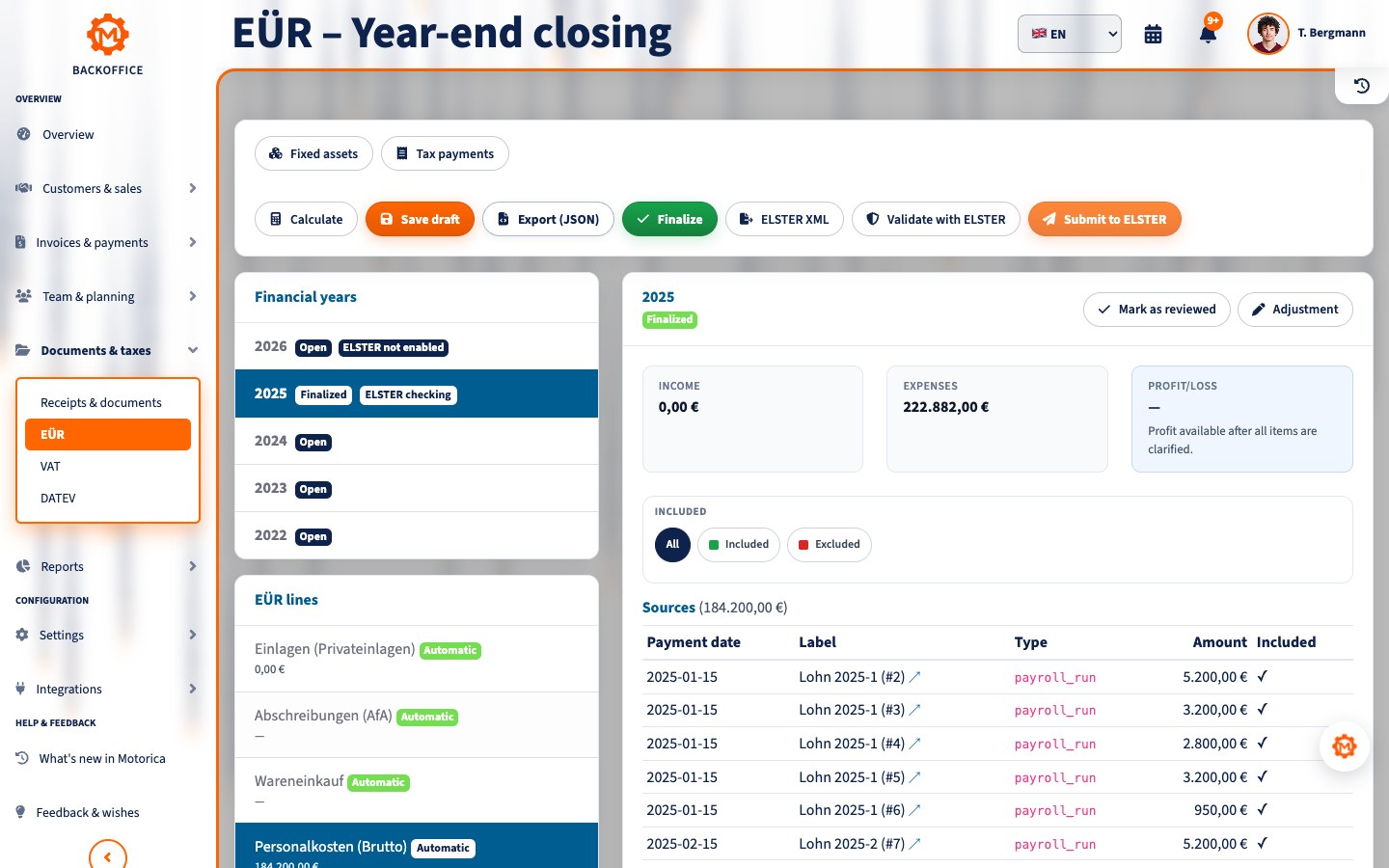
Motorica structures invoices, payments and accounting documents or receipts for tax data preparation, calculates EÜR data from maintained transactions, validates it with ERIC and can transmit it through ELSTER after approval. Tax classification and final review remain with you or your tax adviser.
Conclusion
The EÜR is simplified, not informal. Eligibility, complete payment records, correct VAT and asset treatment, and auditable evidence are essential. Keeping these records current prevents year-end profit from having to be reconstructed from unexplained bank movements.
Sources and date
Current at 16 September 2026.
- Section 4 EStG
- Section 11 EStG
- Sections 6 and 7 EStG
- Section 141 AO
- Section 147 AO
- Section 149 AO
- Sections 238 and 241a HGB
- Section 60 EStDV
- Section 19 UStG
- ELSTER guidance for Anlage EÜR 2025
- German Ministry of Finance: GoBD
This article provides general information and is not individual tax or legal advice.