
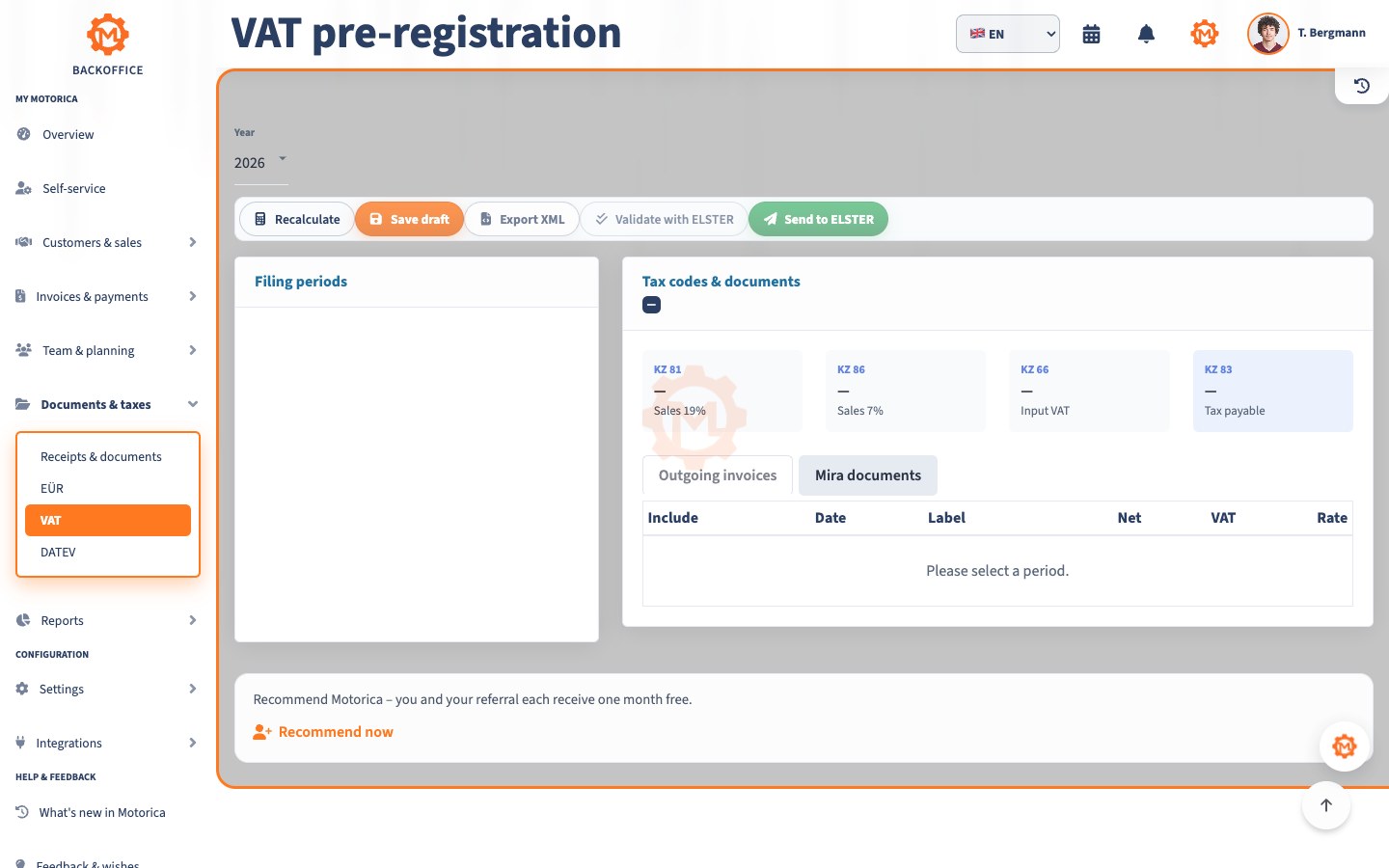
VAT is generally not additional profit. A business under standard taxation charges it to customers, deducts eligible input VAT on business purchases and pays the difference to the tax office. Correct classification, complete invoices and timely filings are essential.
This article explains German VAT law as at 14 September 2026. It is not a substitute for case-specific advice, especially for exempt services, cross-border business or mixed private and business use.
Key facts at a glance
- The standard rate is 19%; a 7% rate or an exemption applies only to transactions specified by law.
- Since 2025, the small-business scheme is a VAT exemption. The thresholds are EUR 25,000 of total turnover in the previous year and EUR 100,000 in the current year. The threshold in the year of formation is EUR 25,000.
- Small businesses do not state VAT separately and generally cannot deduct input VAT.
- Businesses under standard taxation report output and input VAT electronically. Payment is generally due by the tenth day after the filing period.
- A plain PDF is not an e-invoice under German VAT law. Domestic businesses have had to be able to receive e-invoices since 2025; transitional rules apply to issuing them.
- Invoices must generally be retained for eight years under section 14b UStG. Other tax documents may have different retention periods.
How VAT works
Example: you invoice EUR 1,000 net plus EUR 190 VAT. During the same period you purchase business services for EUR 238 gross, including EUR 38 of deductible input VAT. EUR 190 output VAT less EUR 38 input VAT produces EUR 152 payable. If eligible input VAT is higher, a refund may arise.
Keep net revenue and collected VAT separate in your planning. The tax may remain in your bank account until it is filed and paid, but it is not freely available profit. A tax reserve helps prevent cash-flow problems.
Registration with the tax office
When starting self-employment, you generally submit the tax registration questionnaire electronically through ELSTER. It asks about expected turnover, taxation method and the small-business scheme. A trade registration does not replace tax registration.
The tax number identifies the business at the tax office. A VAT identification number (USt-IdNr.) is issued by the Federal Central Tax Office and is particularly relevant for EU business. It is not the same as a personal tax identification number.
Rates and exemptions
Under section 12 UStG, the standard rate is 19%. The reduced rate of 7% applies only to goods and services listed by law. Section 4 UStG also exempts certain medical, educational, insurance or rental transactions.
The correct treatment depends on the individual supply, not merely the profession or sector. “VAT exempt” and “small business” are not the same. If classification is uncertain, clarify the transaction before invoicing.
The small-business scheme in 2026
Under section 19 UStG, domestic transactions of a Germany-based business are exempt when total turnover did not exceed EUR 25,000 in the previous calendar year and does not exceed EUR 100,000 in the current year. These have been net thresholds since 2025. The transaction that breaches the current-year limit is already subject to standard taxation.
In the year a business starts, the actual domestic total turnover is used. The EUR 25,000 threshold is not annualised for a start during the year. All business activities of the same person are considered together.
Small businesses issue invoices without separately stated VAT. The invoice must refer to the exemption under section 19 UStG and contain the details required by section 34a UStDV. A business that nevertheless states VAT may owe it under section 14c UStG.
The trade-off is that input VAT is generally not deductible. Businesses planning substantial investment or serving mainly business customers may opt for standard taxation. This waiver is binding for at least five calendar years.
Standard taxation and input VAT
Under standard taxation, VAT is shown on taxable sales. Section 15 UStG permits input VAT deduction only where the purchase is for the business, all statutory conditions are met and a proper invoice exists. Private portions and certain exempt output transactions are excluded or require apportionment.
Payment or bookkeeping alone does not create a right to deduct input VAT. Check the customer named on the invoice, the actual supply, the invoice and business use. For advance payments, both invoice and payment are required.
Accrual or cash accounting for VAT
Under accrual taxation (Sollversteuerung), VAT generally arises when the service is supplied, even if the customer pays later. Under cash taxation (Istversteuerung), it is calculated on payments received. On application, the tax office may permit cash taxation where previous-year turnover did not exceed EUR 800,000 or for qualifying professional services; details are in section 20 UStG.
Cash taxation can help liquidity, but it is not the small-business scheme. VAT is still stated, input VAT reviewed and returns filed.
Invoices and e-invoices
A regular invoice generally needs full names and addresses, the supplier’s tax number or VAT ID, issue date, unique invoice number, description and date of supply, net amount, tax rate and tax amount, or a reference to an exemption. Special cases require extra wording. Simplifications under section 33 UStDV apply to invoices up to EUR 250.
An e-invoice contains structured data that can be processed automatically, for example XRechnung or compliant ZUGFeRD. A PDF alone is an “other invoice”. The Federal Ministry of Finance e-invoice FAQ states for 2026:
- Since 1 January 2025, domestic businesses, including small businesses, must be able to receive e-invoices; an email inbox is legally sufficient for receipt.
- Until the end of 2026, issuers may use the general transition for paper or, with consent, another electronic format such as PDF.
- If previous-year turnover does not exceed EUR 800,000, that option continues during 2027.
- Small businesses are exempt from issuing e-invoices, but not from receiving them.
Advance returns, payment and annual return
Under section 18 UStG, the advance return and payment are generally due by the tenth day after the filing period. New businesses generally file monthly in the year they start and the following calendar year. Afterwards, the normal period is the quarter; it becomes monthly if previous-year tax exceeded EUR 9,000. At no more than EUR 2,000, the tax office may release the business from advance filings.
An approved permanent filing extension shifts the deadline by one month. Monthly filers generally make a special advance payment. An annual VAT return is also required unless an exception applies. Small businesses normally do not file it, but reverse charge, intra-Community acquisitions or a request by the tax office can still create filing duties.
Cross-border business and reverse charge
Standard domestic rules are often insufficient across borders. Place of supply, the customer’s business status, VAT IDs, evidence and invoice wording determine the treatment. Under reverse charge, the customer owes VAT for certain B2B services; section 13b UStG also covers specified domestic transactions.
Intra-Community supplies and certain EU services may require a recapitulative statement. Platform sales, digital services, distance sales, imports and exports have additional rules. Small businesses can also owe VAT on services purchased abroad. Clarify cross-border transactions before ordering or invoicing.
Retention and corrections
Under section 14b UStG, issued and received invoices must generally be kept for eight years, starting at the end of the year of issue. They must remain readable, unaltered and auditable. Different periods may apply to other accounting records, commercial correspondence and tax documents.
Do not silently delete or overwrite an incorrect invoice. A correction must refer clearly to the original. Where e-invoicing is mandatory, a correction generally also needs a structured format, subject to the applicable transitional relief.
Practical checklist
- Complete tax registration through ELSTER and record the tax number.
- Choose the small-business scheme or standard taxation deliberately and monitor thresholds.
- Check the rate or exemption for each type of supply.
- Configure accrual or approved cash taxation correctly.
- Check outgoing invoices before sending them.
- Verify incoming invoices and business use before deducting input VAT.
- Be able to receive, review and preserve e-invoices in their original format.
- Reconcile output and input VAT continuously and reserve the expected payment.
- Document ELSTER deadlines, payments and transmission receipts.
- Review EU, non-EU and reverse-charge transactions separately.
Common mistakes
- Confusing turnover with profit: the small-business thresholds relate to statutory total turnover, not profit or income.
- Spending collected VAT: without a reserve, payment can create a cash-flow gap.
- A small business stating VAT: an unauthorised statement can create a tax liability.
- Deducting input VAT automatically: a business purpose and proper invoice are required.
- Treating a PDF as an e-invoice: structured, machine-readable data are decisive.
- Reconciling only at year-end: missing documents and wrong tax codes should be resolved before the advance return.
- Treating foreign business like domestic business: place of supply, reverse charge and reporting may change the result completely.
Frequently asked questions
Must every self-employed person charge VAT?
No. A transaction may be exempt by law or under the small-business scheme. Otherwise VAT will generally apply. The actual supply matters, not the label “self-employed”.
Do the EUR 25,000 and EUR 100,000 limits refer to profit?
No. They refer to total turnover under section 19(2) UStG. The actual EUR 25,000 limit applies in the formation year; later years test the previous and current years separately.
Can a small business deduct input VAT?
Generally not where purchases support transactions exempt under section 19 UStG. That is why standard taxation can be better for substantial investments.
When does VAT arise if the customer does not pay?
Under accrual taxation, generally when the supply is made; under approved cash taxation, generally when payment arrives. Bad debts may allow a correction under section 17 UStG.
Is a PDF invoice sufficient in 2026?
The transition may still allow paper or, with consent, a PDF for many issuers in 2026. But a PDF is not an e-invoice. Businesses already need to receive e-invoices, and public contracts or special cases may have stricter rules.
How long must invoices be retained?
Generally eight years for VAT purposes from the end of the year of issue. Check separate periods for other tax and commercial records; a longer period may apply in a particular case.
Does accounting software replace a tax review?
No. Software can organise tax codes, documents, deadlines and reports. Correct classification, special-case review and approval of the filing remain the business’s responsibility and, where needed, its tax adviser’s.
Conclusion
A reliable VAT process starts with every document: classify the supply, check the invoice, post the tax correctly, monitor the deadline and retain the evidence. Separating small-business rules, input VAT and e-invoicing avoids the most common errors.
Motorica helps organise invoices, documents, payments and deadlines. It does not replace the tax decision or review.
Sources and date
Reviewed 14 September 2026. Key official sources include section 12 UStG, section 13b UStG, sections 14 to 14c UStG, section 15 UStG, section 18 UStG, section 19 UStG, section 20 UStG, sections 33 and 34a UStDV, the BMF guidance on the small-business scheme, the BMF e-invoice FAQ, ELSTER and the BZSt guidance on recapitulative statements.
This article provides general orientation on German VAT law and is not individual tax or legal advice. Obtain qualified advice before invoicing or reporting an unclear or cross-border transaction.