
Cash-register receipts, payment receipts and invoices are often treated as the same thing in everyday business. Under German law, however, they serve different purposes. The heading on the document is not decisive; its content is. A till receipt can also qualify as an invoice, while an invoice does not automatically prove that it has been paid.
This guide explains German rules as at 14 September 2026.
The difference in one sentence
- Invoice (Rechnung): It accounts for a supply or service and states the amount due. It may be issued before or after payment.
- Payment receipt (Quittung): It acknowledges receipt of performance, usually payment. A person who has paid can generally request written acknowledgement under section 368 of the German Civil Code (BGB).
- Cash-register or till receipt (Kassenbeleg/Kassenbon): It records a transaction captured by an electronic cash-register system. Depending on its content, it may also be a simplified low-value invoice or a full invoice.
Why the label is not decisive
Under section 14 of the German VAT Act (UStG), any document that accounts for a supply or other service is an invoice, regardless of what it is called in business. A document headed “receipt”, “voucher” or “till receipt” can therefore be an invoice for VAT purposes if it contains the required information.
Conversely, writing “invoice” at the top does not make an incomplete document valid. To deduct input VAT, a business must generally hold an invoice issued in accordance with sections 14 and 14a UStG. A bank statement or proof of payment can show that money changed hands, but it does not normally replace the required invoice.
When is a till receipt sufficient as an invoice?
For a total amount of up to €250 gross, the simplified rules for low-value invoices under section 33 of the German VAT Implementing Regulation (UStDV) apply. The document must contain at least:
- the supplier’s full name and address,
- the date of issue,
- the quantity and type of goods or the scope and type of service,
- the gross amount and applicable VAT rate, or a reference to the VAT exemption.
The customer’s name and address, a tax number, invoice number and a separately stated VAT amount are not required on an ordinary low-value invoice. The simplification does not apply to certain cases, including intra-Community supplies, particular cross-border distance sales and reverse-charge transactions.
Many till receipts meet these requirements. If a required item is missing or the total exceeds €250, a business should request a proper invoice. A till receipt is therefore not automatically inferior to an invoice; the amount, transaction and content matter.
What must a regular invoice contain?
Section 14(4) UStG generally requires:
- the full name and address of both supplier and customer,
- the supplier’s German tax number or VAT identification number,
- the date of issue,
- a sequential invoice number uniquely assigned by the issuer,
- the quantity and customary description of the goods or the scope and type of service,
- the date of supply or service,
- the consideration broken down by VAT rates and exemptions, including any agreed reductions not already included,
- the VAT rate and amount, or a reference to the exemption,
- any further legally required wording, such as “Gutschrift” for self-billing or “Steuerschuldnerschaft des Leistungsempfängers” for reverse charge.
The place of supply and the customer’s VAT ID are not general mandatory particulars on every invoice. Special and cross-border transactions may nevertheless require additional information under section 14a UStG.
Supplies by a German small business applying the exemption in section 19 UStG are subject to the simplified particulars in section 34a UStDV. The invoice must state that the small-business exemption applies, and VAT must not be shown separately.
What does a payment receipt prove?
A Quittung is a written acknowledgement of receipt under section 368 BGB. It usually confirms that the creditor received a specified amount. Useful particulars include:
- the payer and recipient,
- amount and currency,
- purpose or related invoice,
- date and place,
- the recipient’s signature.
It primarily answers “Was payment received?” An invoice answers “What is being charged and how much?” If a payment receipt also contains every required VAT invoice particular, it can serve both functions. Otherwise, it is only evidence of payment.
What is special about a cash-register receipt?
A business that records reportable transactions with an electronic recording system must generally issue and provide a receipt immediately under section 146a(2) of the German Fiscal Code (AO). It may be supplied on paper or, with the recipient’s agreement, electronically.
Section 6 of the Cash Register Security Regulation (KassenSichV) requires information including the business, transaction times, supply, transaction number, total and VAT rate, as well as identifiers for the register and certified technical security system. These technical cash-register particulars do not replace the VAT invoice requirements; both sets of rules may apply at the same time.
In an ordinary retail transaction, a customer does not have to take an offered till receipt. The business must nevertheless issue and make it available unless the tax authority has granted an exemption.
E-invoices: what applies in 2026?
Since 2025, an E-Rechnung is only an invoice in a structured electronic format that enables electronic processing. A simple PDF is a “other invoice”, not an E-invoice. Common compliant formats include XRechnung and ZUGFeRD from version 2.0.1, except the MINIMUM and BASIC-WL profiles.
For domestic German B2B transactions:
- Since 1 January 2025, domestic businesses must be able to receive E-invoices; an email inbox can be sufficient.
- Until 31 December 2026, all issuers may still use paper invoices or, with the recipient’s agreement, simple PDF invoices.
- In 2027, this transition continues for issuers whose previous-year turnover did not exceed €800,000 and for certain EDI procedures.
- From 2028, E-invoicing is generally mandatory for transactions within the relevant domestic B2B scope.
Exceptions include low-value invoices up to €250, passenger tickets and supplies by businesses applying the small-business exemption. Small businesses must still be able to receive E-invoices. Separate B2G rules apply to invoices sent to public authorities.
How long must documents be retained?
Businesses must generally retain copies of outgoing invoices and all incoming invoices for eight years under section 14b UStG. Accounting vouchers, including business till receipts and payment receipts, must also generally be retained for eight years under section 147 AO. The period normally starts at the end of the calendar year in which the invoice was issued or the accounting voucher arose. It may run longer where the records remain relevant to an open tax procedure.
Throughout the retention period, records must remain complete, legible, available and traceable. For an E-invoice, at least the structured original component must be preserved unchanged; storing only a PDF visualisation is not enough. Thermal paper can fade, so a legible digital image should be captured promptly and filed systematically. Whether the paper may then be destroyed depends on the documented GoBD-compliant process and any non-tax requirements.
A practical decision guide
- Prove payment: If you need evidence that payment was made, keep a Quittung or other payment record.
- Prove the supply and VAT: If you need valid billing or want to deduct input VAT, check the invoice particulars.
- Check the amount: Up to and including €250 gross, a complete till receipt may qualify as a low-value invoice.
- Check special rules: Cross-border supplies, reverse charge, small businesses, hospitality expenses and public-authority invoices may require more.
- Check E-invoicing: Determine whether the transaction falls within German domestic B2B rules and whether a 2026 transition is being used.
- Archive systematically: Link the invoice to its payment evidence and any hospitality or performance records without altering original data.
Common mistakes
“The invoice proves it was paid.” No. It initially records the charge. Payment may be evidenced by a receipt, bank statement or payment-system status.
“A till receipt can never support input VAT deduction.” Too broad. Up to €250 gross, it may qualify as a low-value invoice if section 33 UStDV is satisfied and no excluded special case applies.
“A payment receipt always replaces the invoice.” No. It proves payment but need not contain the invoice particulars.
“A PDF is an E-invoice.” Not since 2025. A simple PDF is unstructured and counts as another invoice.
“Incoming invoices are kept for five years and outgoing invoices for ten.” Incorrect. The general VAT retention period is eight years for both.
Frequently asked questions
Can I request a receipt after paying cash?
Yes. Section 368 BGB generally entitles the debtor to request written acknowledgement when performance is received. In many cash-register situations, the till receipt performs this evidential role in practice.
Can a till receipt also be an invoice?
Yes. Up to €250 gross, a receipt with all low-value invoice particulars is often sufficient. Above €250 it must contain the regular invoice particulars unless another special rule applies.
Is a bank statement enough to deduct input VAT?
A bank statement proves payment but is generally not an invoice. Input VAT deduction normally requires possession of a valid invoice.
Must every invoice show a VAT ID?
No. A regular invoice generally needs either the supplier’s German tax number or VAT ID. Ordinary low-value invoices up to €250 require neither. Special cases may differ.
Is an E-invoice required for cash payment?
Payment method does not change the E-invoice rules. A domestic B2B purchase over €250 may require an E-invoice once no transition or exception applies.
Conclusion
Invoices, payment receipts and till receipts are not rigid opposites. The invoice records the charge, the payment receipt acknowledges payment and the till receipt records the cash-register transaction. One document can perform several functions if it contains the required particulars for each.
Check the amount, transaction and content rather than only the heading. In day-to-day business, link the invoice and payment evidence and retain both in a traceable way.
Next step
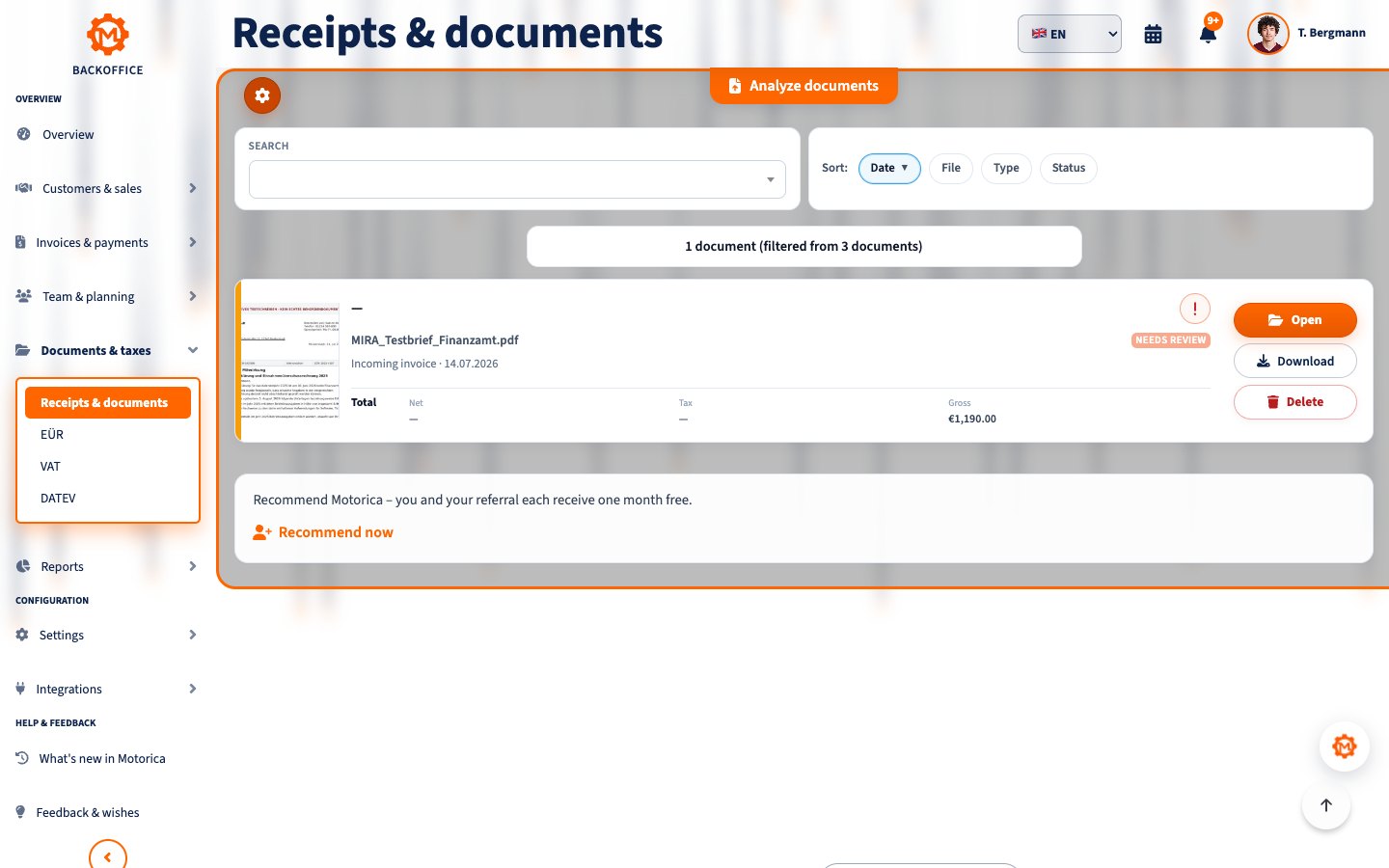
Motorica.io helps you organise invoices, payments and receipts in one place and identify missing evidence more easily.
Sources and date
Current as at 14 September 2026
- Section 14 UStG – issuing invoices
- Section 14a UStG – additional duties in special cases
- Section 14b UStG – invoice retention
- Section 15 UStG – input VAT deduction
- Section 33 UStDV – low-value invoices
- Section 34a UStDV – invoices issued by small businesses
- Section 146a AO – electronic recording systems and receipt duty
- Section 147 AO – retaining records
- Section 6 KassenSichV – receipt requirements
- Section 368 BGB – written acknowledgement
- German Finance Ministry – E-invoice questions and answers, March 2026
This article provides a general overview of German law and is not individual tax or legal advice. Discuss special cases with a tax adviser or another qualified professional.