
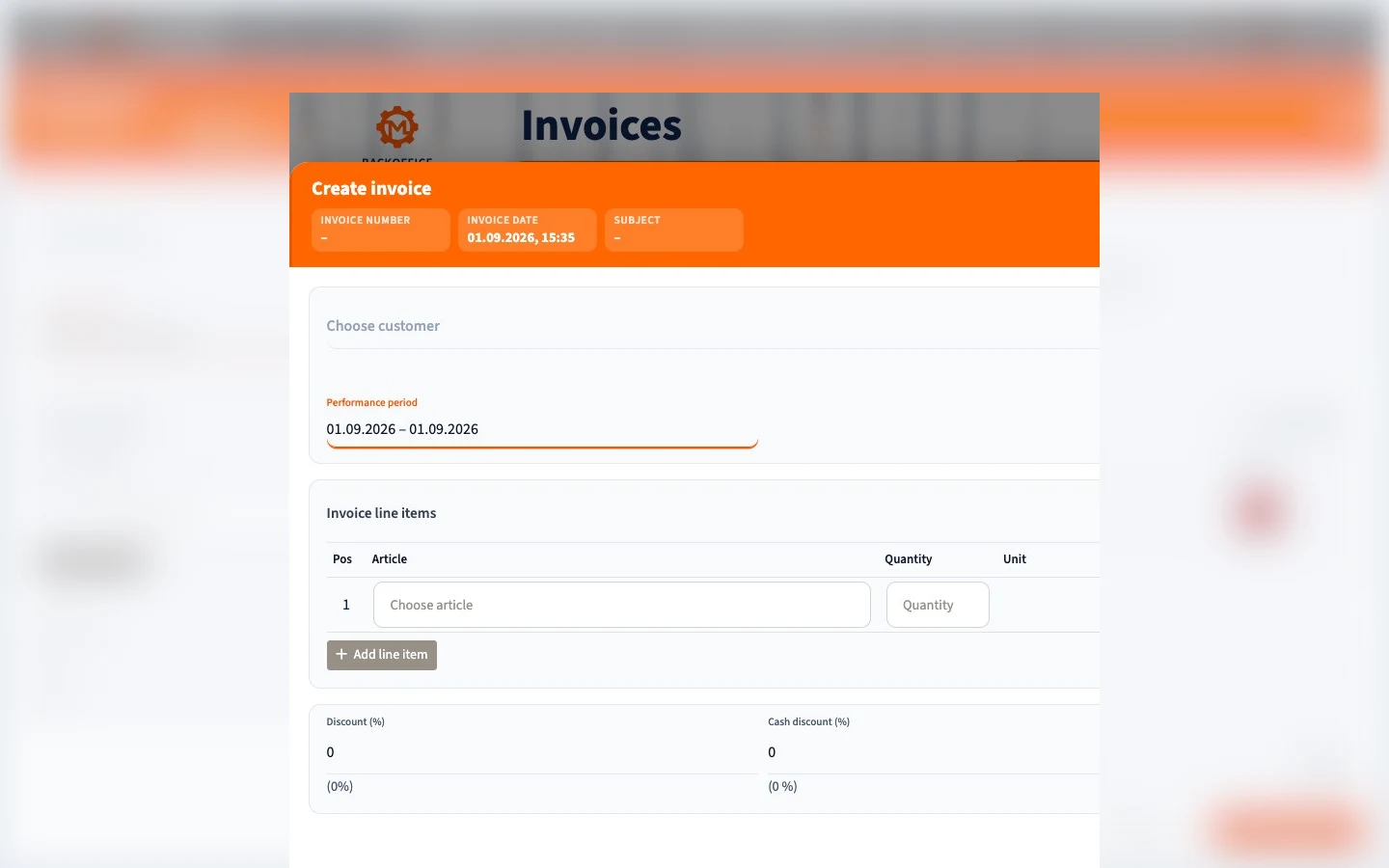
An invoice for a transaction in Germany needs the information required for that transaction. An ordinary invoice above €250 generally follows section 14(4) of the German VAT Act (UStG). Small-value invoices and invoices issued under the German VAT exemption scheme for small businesses (Kleinunternehmerregelung) have different rules. This guide explains German law, including the exceptions that matter in practice.
Required details on an ordinary invoice
Check the following for a standard invoice:
- The full names and addresses of both the supplier and the customer.
- The supplier’s German tax number or VAT identification number. A personal tax identification number is not a substitute.
- The invoice issue date and a unique sequential invoice number. Numbering may use more than one series, but the number must identify one invoice only.
- The quantity and customary description of goods, or the scope and nature of services. “Services” alone is too vague.
- The date or period of supply. A calendar month may suffice under section 31(4) UStDV; an advance-payment invoice can instead require the known date of receipt of payment.
- The amount before VAT, separated by VAT rate and exemption, and any advance-agreed discount not already included.
- The applicable VAT rate and VAT amount, or a reference to the relevant exemption.
Further details apply in particular cases: a notice of the customer’s two-year retention duty for certain property-related services to private customers; the word “Gutschrift” when the customer issues an agreed self-billed invoice; and notices or VAT IDs under section 14a UStG for certain cross-border or reverse-charge transactions.
An email address, phone number, IBAN, payment term and physical place of performance are not general statutory invoice details. They can still be useful or required for a particular case. German VAT law does not generally require the customer’s language on the invoice; any translation must preserve the legally relevant meaning.
A simple VAT example
Suppose a business charges €100.00 before VAT for a clearly described service to which 19% VAT actually applies. It shows €19.00 VAT and €119.00 total. It must also include the other applicable details, especially both addresses, the supplier’s tax number or VAT ID, the invoice number and the supply date. The example rate does not apply to every service.
Small-value invoices up to €250
If the total including VAT does not exceed €250, section 33 UStDV generally requires only the supplier’s name and address, issue date, a meaningful description and quantity or scope, and the total with the VAT rate or exemption notice. The customer’s name, tax number and invoice number are generally unnecessary. The simplification does not cover, among other things, intra-EU supplies, certain distance sales or reverse-charge cases. A till receipt can serve as an invoice if it contains the required details.
Invoices under the small-business VAT exemption
Section 34a UStDV sets the minimum details for sales exempt under section 19 UStG: both names and addresses; the supplier’s tax number, VAT ID or small-business identification number; issue date; a specific description of the goods or services; the total; and a notice that the small-business exemption under section 19 UStG applies. Do not show VAT separately for such a sale. Section 34a normally requires neither an invoice number nor a supply date; the small-value rules can still apply. A customer-issued invoice additionally needs the word “Gutschrift”.
E-invoices and the 2026 transition
A plain PDF has not counted as a structured VAT e-invoice since 2025. Suitable formats include XRechnung and qualifying ZUGFeRD profiles. German businesses have had to be able to receive e-invoices since 1 January 2025; an email mailbox is initially sufficient.
For domestic B2B transactions otherwise subject to the issuing duty, suppliers may still use other invoices through 31 December 2026. If the supplier’s previous-year turnover was at most €800,000, the transition extends through 31 December 2027. During these periods, a plain PDF needs the recipient’s consent; paper is allowed. The issuing duty is not simply triggered by the current invoice amount or a turnover threshold. Exceptions include invoices up to €250, supplies by small businesses and certain VAT-exempt transactions. Public-sector customers can impose separate B2G rules. An e-invoice must contain all required tax details in its structured data.
Create, correct and retain the invoice
First establish the parties, type of transaction and any special tax treatment. Describe the supply precisely; check the supply date, amounts, tax rate, addresses and numbering. Choose a valid format and delivery channel. In certain B2B and property-related cases, an invoice generally must be issued within six months of the supply.
Keep copies of issued invoices and received invoices for eight years under section 14b UStG. The period starts at the end of the issue year and may extend for unresolved tax proceedings. Retain the structured original of an e-invoice. To correct an error, issue a document clearly linked to the original under section 31(5) UStDV; do not silently overwrite a sent invoice. A full cancellation is not needed for every typo.
Checklist before sending
- Is this a standard, small-value, small-business or special-case invoice?
- Are names, addresses, supplier tax identifier, date and any required invoice number correct?
- Are the goods or services and supply date or period clear?
- Do net amount, tax treatment, VAT and total reconcile?
- Are exemption, reverse-charge or self-billing notices included where required?
- Are format, delivery channel and retention arrangements appropriate?
Frequently asked questions
Is an IBAN mandatory?
No. It helps customers pay but is not one of the general details in section 14(4) UStG.
Must invoice numbers have no gaps?
The number must be uniquely assigned in a sequential series and identify the invoice. A traceable numbering system matters; this does not mean that every visible numerical sequence must be gapless.
Can an invoice be written in English?
German VAT law does not generally prescribe German as the invoice language. The required information must remain clear and verifiable. Check a recipient’s requirements separately.
Sources and scope
Checked on 16 September 2026 against section 14 UStG, section 14a UStG, section 14b UStG, sections 31, 33 and 34a UStDV, and the German Finance Ministry’s e-invoice FAQ. This overview concerns German law and is not individual tax or legal advice. Seek qualified advice for cross-border and unusual cases.