
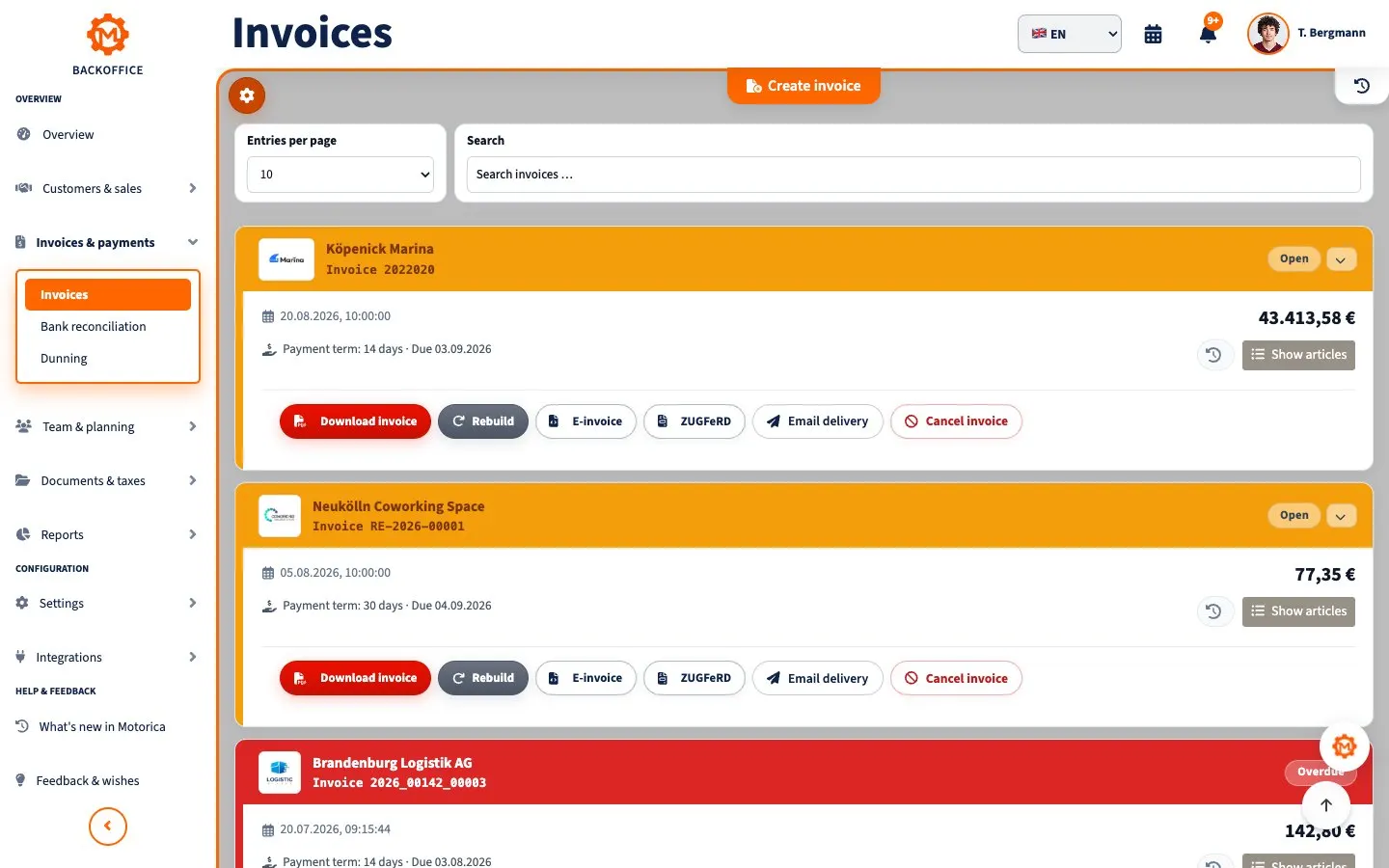
XRechnung and ZUGFeRD are two established ways of exchanging structured electronic invoices in Germany. Their key difference is the container: XRechnung is a pure XML file, while ZUGFeRD combines structured XML data with a human-readable PDF/A-3 document. The right choice depends on the law, the recipient’s technical requirements and the agreed transmission channel—not simply on “public authority versus business”.
This guide explains German requirements. It is general information, not individual legal or tax advice.
In brief
Since 1 January 2025, an e-invoice for German VAT purposes must use a structured electronic format that enables automated processing. A normal PDF is therefore no longer an e-invoice; it is classed as an “other invoice”.
XRechnung is Germany’s implementation of European standard EN 16931. It contains structured invoice data only and can use the UBL or UN/CEFACT CII XML syntax. Although designed primarily for public administration, it can also be used between businesses.
ZUGFeRD/Factur-X is a hybrid format. Structured XML invoice data is embedded in a PDF/A-3 file. People read the PDF view, while accounting systems process the XML. ZUGFeRD and the French Factur-X standard are technically identical.
As of this review, XRechnung version 3.0 with bundle 3.0.2 and ZUGFeRD 2.5.2/Factur-X 1.09.2 are current. ZUGFeRD 2.5.2 has applied since 1 September 2026.
The essential difference
An XRechnung is structured XML. A PDF view is not part of the format, so users need a viewer; the German tax administration also provides an ELSTER e-invoice viewer.
In a ZUGFeRD file, the PDF view and XML record share one PDF/A-3 container. Since 2025, the structured data is decisive for German VAT purposes if the two parts conflict. Both should therefore be produced from the same source and checked before dispatch.
XRechnung is not reserved for public authorities, and ZUGFeRD is not limited to B2B. ZUGFeRD can in principle be used for B2B, B2G and B2C. For public-sector invoices, however, the specific authority decides which format, profile and channel it accepts. A ZUGFeRD XRECHNUNG profile submitted to the German federal administration may be accepted as pure XML; an arbitrary hybrid PDF is not automatically sufficient.
Which ZUGFeRD profiles qualify?
ZUGFeRD has five profiles: MINIMUM, BASIC WL, BASIC, EN 16931 and EXTENDED. XRECHNUNG is an additional sixth reference profile. For German VAT purposes, ZUGFeRD from version 2.0.1 generally qualifies as an e-invoice except for MINIMUM and BASIC WL.
EN 16931 is often suitable for ordinary domestic invoices. BASIC carries fewer data fields; EXTENDED covers additional business requirements. The XRECHNUNG profile follows German XRechnung rules. The file name or logo proves nothing: the XML must actually comply with the selected profile, EN 16931 and the applicable business rules.
What applies in 2026?
German-established businesses have had to be able to receive e-invoices since 1 January 2025. In B2B, an email inbox can be sufficient. Small-business VAT-exempt traders must also be able to receive them, although their own supplies are exempt from the obligation to issue an e-invoice.
Transitional rules apply to issuing invoices. Until 31 December 2026, issuers may still use paper or—with the recipient’s consent—a normal PDF for domestic B2B transactions. If the issuer’s previous-year turnover did not exceed EUR 800,000, this option generally continues until the end of 2027. After the applicable transition expires, covered domestic B2B supplies require an e-invoice.
Exceptions include invoices up to EUR 250 gross, transport tickets, supplies by small-business VAT-exempt traders, many VAT-exempt supplies and B2C transactions. Special cases require separate review.
Public procurement follows additional federal, state and municipal rules. The federal E-Invoicing Ordinance has generally required electronic invoices since 27 November 2020, with an exception for direct awards up to EUR 1,000. These B2G rules must not be confused with the B2B transition periods.
How to choose and send the right format
- Classify the transaction: Identify B2B, B2G or B2C, the establishments involved, and any exception or transition.
- Ask for recipient requirements: Confirm format, profile, buyer reference, Leitweg-ID, purchase order number and transmission channel.
- Generate a current format: Use the current XRechnung version and supported XML syntax, or a suitable EN-16931-compliant ZUGFeRD profile.
- Include all mandatory data in the structured part: This normally includes full supplier and customer names and addresses, the supplier’s tax number or VAT ID, issue date, unique invoice number, supply description and date, net amounts, VAT rate and VAT amount or an exemption reference. Further data may be required.
- Validate technically: Check the XML schema, code lists, EN 16931 rules and the chosen XRechnung or ZUGFeRD profile rules.
- Review the business content: A technically valid invoice may still contain the wrong recipient, tax treatment, totals or bank details.
- Use the required channel: B2B may use email, an interface or a portal. Authorities often prescribe a portal or Peppol. Federal invoices may require ZRE or OZG-RE.
- Retain the structured original: Keep the structured part intact in its original form. The German VAT retention period is generally eight years, starting at the end of the calendar year in which the invoice was issued.
Checklist
- Transaction and applicable B2B or B2G rules identified
- Current XRechnung or ZUGFeRD version selected
- Suitable e-invoice-capable ZUGFeRD profile used
- Mandatory VAT data included in the structured part
- Buyer reference, Leitweg-ID and order number entered as required
- Tax, totals, units, payment and bank data reviewed
- XML validated against schema, code lists and business rules
- ZUGFeRD PDF view compared with its XML data
- Correct channel used and delivery status recorded
- Structured original retained intact and machine-readable
Common mistakes
Treating a normal PDF as an e-invoice: It lacks structured invoice data and has been an “other invoice” since 2025.
Using “XRechnung for authorities, ZUGFeRD for B2B” as a fixed rule: Both formats have broader uses. The recipient’s rules determine acceptance.
Using MINIMUM or BASIC WL without checking: These profiles do not meet the German VAT requirements for an e-invoice.
Allowing PDF and XML to differ: In ZUGFeRD, the structured part is decisive. A correct-looking PDF cannot cure incorrect XML data.
Assuming every e-invoice needs a qualified signature: German law lists qualified electronic signatures as one way of ensuring authenticity and integrity, but not as a universal requirement. A reliable audit trail through internal controls may also suffice.
Keeping only the visible PDF: The structured part must be retained intact in its original form. Any additional tax-relevant information in the PDF must also be preserved.
Frequently asked questions
Is XRechnung always XML?
Yes. It is transmitted using an approved XML syntax such as UBL or CII. A generated PDF is only a visualisation, not the XRechnung itself.
Is every ZUGFeRD file an e-invoice?
No. Version, profile and actual conformity matter. German Finance Ministry guidance generally recognises ZUGFeRD from 2.0.1, but excludes MINIMUM and BASIC WL.
Do B2B invoices need a Leitweg-ID?
Generally not. A Leitweg-ID routes invoices to German public-sector recipients. B2B may use another buyer reference in field BT-10, subject to the recipient’s requirements.
Must an e-invoice be electronically signed?
Not in every case. Authenticity, integrity and readability must be ensured, but a qualified signature is only one permissible method.
Is technical validation enough?
No. It finds format and business-rule errors but cannot confirm that the supply, customer, VAT treatment or bank account is factually correct.
How long must e-invoices be kept?
Generally eight years for German VAT purposes. The structured part must remain intact, available and machine-readable. Other retention duties may also apply.
Conclusion
XRechnung and ZUGFeRD are not two labels for the same file. XRechnung is pure structured XML; ZUGFeRD combines XML with PDF/A-3. Either can meet e-invoice requirements when the current version, correct profile, complete mandatory data and recipient specifications all align. Technical validation, a separate factual review and proper retention of the structured original prevent most rejections.
Next step
Before sending your first production e-invoice, confirm the required format, references and channel with the recipient. If you want to organise invoices, quotes and receipts centrally, you can try Motorica.io.
Sources and review date
Reviewed: 14 September 2026
- German Finance Ministry: mandatory e-invoicing FAQ
- German VAT Act, section 14
- German VAT Act, section 14b
- German Federal E-Invoicing Ordinance
- KoSIT: XRechnung versions and bundles
- KoSIT: XRechnung FAQ
- FeRD: ZUGFeRD 2.5.2
- German Finance Ministry: GoBD amendment for e-invoices
This article is a general overview of German requirements and does not replace individual legal or tax advice.