
At the end of a financial year, a sole proprietor in Germany must determine the business profit and prepare the relevant tax returns. That does not always mean producing a statutory annual financial statement. Many founders may use an income and expenses statement (Einnahmenüberschussrechnung, EÜR). This guide explains when an EÜR is possible, what a balance sheet involves, and which year-end tasks matter.
EÜR or balance sheet?
Under section 4(3) of the German Income Tax Act (EStG), a person who is neither legally required to keep books and prepare financial statements nor voluntarily does both can generally calculate profit as business income minus business expenses. A merchant required to keep books prepares a balance sheet and profit and loss statement (GuV); together they form the annual financial statements under section 242 of the Commercial Code (HGB). Tax balance-sheet data normally has to be transmitted electronically.
For individual merchants, section 241a HGB offers an exemption where turnover does not exceed €800,000 and annual surplus does not exceed €80,000 at two consecutive year ends. For a newly founded business, the first year end is decisive. This is not a universal EÜR threshold. Separately, the tax office may establish an accounting duty for a commercial business under section 141 of the Fiscal Code (AO) if annual total turnover exceeds €800,000 or business profit exceeds €80,000. That duty normally starts in the financial year following notification by the tax office. A freelance profession is not subject to section 141 AO solely because of its income level. Other obligations must still be checked.
The German VAT exemption scheme for small businesses (Kleinunternehmerregelung) concerns VAT. It does not decide whether the business needs an EÜR or balance sheet.
Practical year-end sequence
1. Confirm your accounting method
Check the nature of the activity, merchant status, past accounting method and any notices from the tax office. Discuss borderline cases and a voluntary switch with a tax adviser.
2. Complete the records
Collect issued and received invoices, each accounting document or receipt, bank and cash records, payment-provider statements, contracts and payroll information where relevant. Perform bank transaction reconciliation and match payments to invoices. Keep unpaid invoices visible without treating them automatically as money received for an ordinary EÜR.
3. Allocate payments to the correct year
For an EÜR, the actual receipt or payment date is normally decisive (section 11 EStG). An invoice dated in December and paid in January usually belongs to January's year. A narrow exception applies to regularly recurring items shortly around year end; economic allocation and due date also matter. Advance payments and some purchases have separate rules.
4. Separate private and business transactions
Owner deposits and withdrawals are generally not ordinary business income or expenses. Loan proceeds are not profit and repayment of principal is normally not an expense, although business interest may be deductible. Document the business share of mixed-use assets. Check the treatment of VAT collected and input VAT.
5. Check assets and depreciation
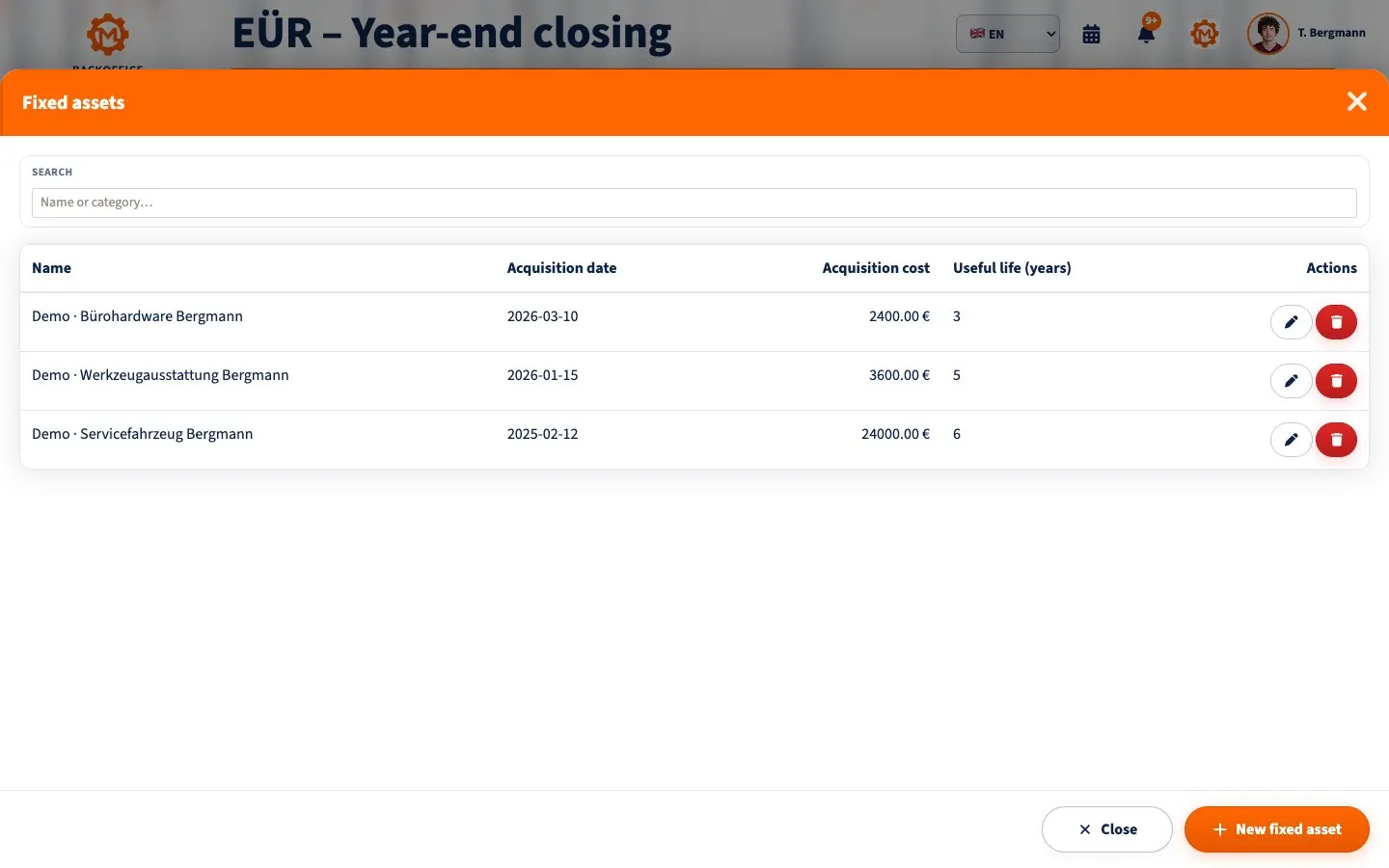
An asset used over several years cannot always be deducted immediately. Review acquisition cost, useful life, depreciation (AfA), low-value asset rules and the asset register under sections 4, 6 and 7 EStG. These rules apply to EÜR users as well.
6. Prepare the EÜR or financial statements
Map income and expenses to the official EÜR categories and reconcile totals with receipts, payments, VAT advance returns and the previous year. A balance sheet needs further work, including inventory, receivables, liabilities, period allocation and possibly provisions. A balance sheet is not merely a longer EÜR.
Which returns must be filed?
Business profit flows into the proprietor's personal income tax return, usually through Anlage G for trade or Anlage S for freelance income. Anlage EÜR normally has to be sent electronically in the official format; the tax office may waive electronic filing on request in cases of undue hardship. Businesses using balance-sheet accounting normally transmit an E-Bilanz.
A trade tax return is required for a commercial sole proprietor in particular when trade income exceeds €24,500, a trade loss carryforward exists, or the tax office requests a return (section 25 of the Trade Tax Regulation). The €24,500 allowance does not mean every trader must always file. Freelance income is generally outside trade tax.
For taxable VAT transactions, check the annual VAT return and reconcile advance returns. Since 2025, the Kleinunternehmerregelung generally excludes the standard filing duties under section 18(1)–(4) VAT Act; special transactions or a tax-office request can still create duties. Small-business VAT exemption never removes the duty to determine taxable income.
Deadlines and retention
Without a tax adviser, the ordinary deadline is generally 31 July of the following year. With professional preparation it is generally the last day of February in the second following year (section 149 AO). A weekend, public holiday, special rule or individual request may change the actual date. Budget for tax payments and adjusted advance payments.
Keep records complete, readable and retrievable. Under section 147 AO, books, inventories and annual financial statements normally have a 10-year retention period; accounting vouchers 8 years; and some other records 6 years. The period generally begins at the end of the calendar year in which the record arose or the statement was prepared. Open tax proceedings may extend it. Preserve the structured original data of an electronic invoice.
Founder checklist
- Confirm EÜR eligibility or accounting duty
- Reconcile bank, cash and payment services
- Record invoices, vouchers and payment dates
- Separate owner transactions and loans
- Review year-end payment allocation
- Check assets, depreciation and asset register
- Reconcile VAT and input VAT
- Complete Anlage EÜR or balance sheet and GuV
- Check tax returns and the actual deadline
- Plan retention and possible tax payments
Common questions
Is an EÜR an annual financial statement? In everyday speech it is part of year-end work. Legally, the HGB annual financial statements consist of a balance sheet and GuV; an EÜR is a different profit calculation.
Does an unpaid invoice belong in the EÜR? Normally only once payment arrives. Keep the open invoice documented and check exceptions.
Do I need a separate EÜR for each business? The EÜR form can be transmitted for a business separately. Distinct businesses should not be mixed without checking their tax treatment.
When should I seek help? Especially for a first balance sheet, turnover thresholds, international transactions, employees, vehicles, real estate, business closure or a change of method.
See the EÜR in the Backoffice
This short animation shows the EÜR summary, a payroll source and the fixed-asset register in Thomas Bergmann’s fictional demo account.
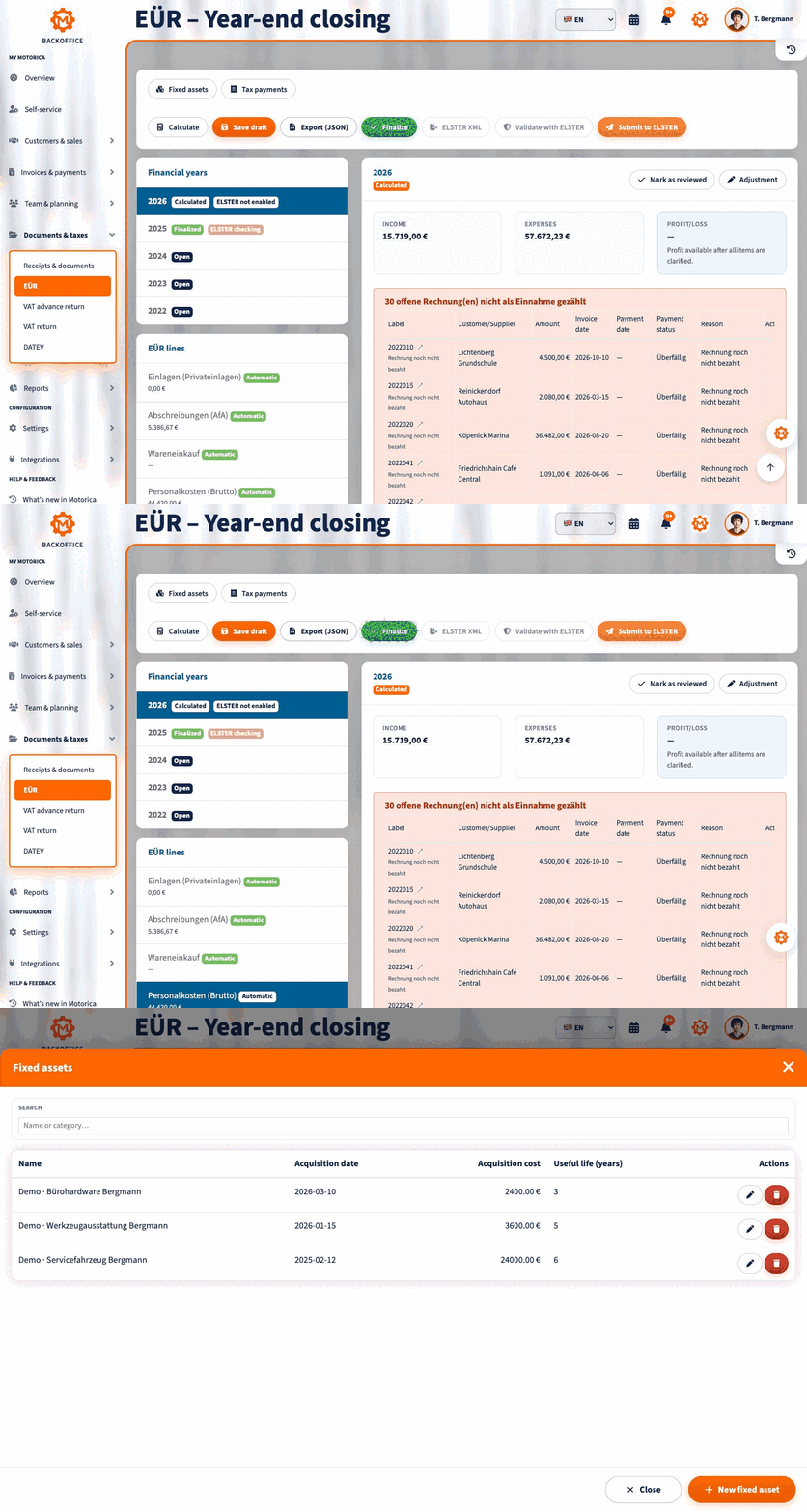
EÜR summary · Payroll source · Fixed assets
Motorica and official sources
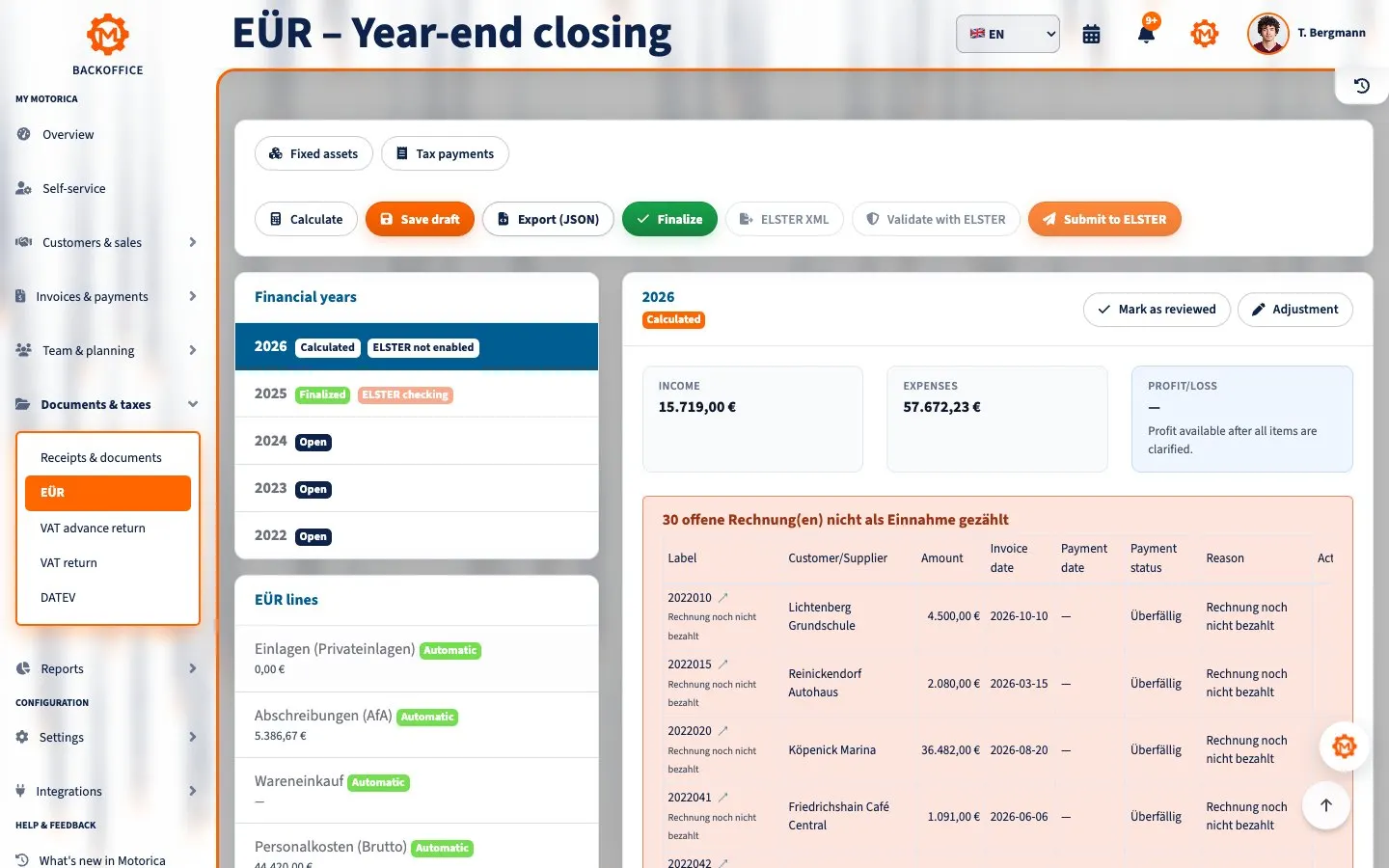
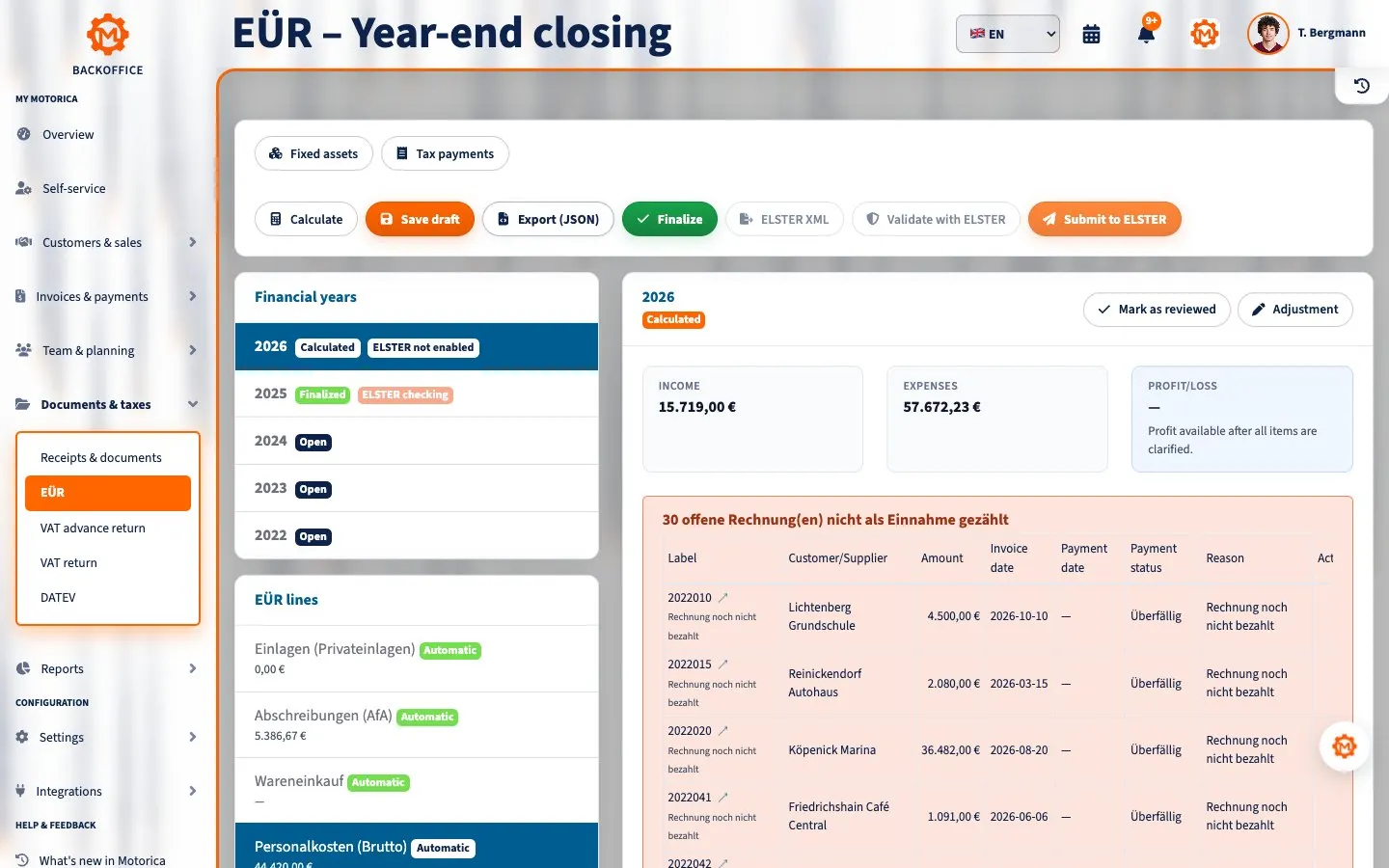
The Motorica back office displays EÜR lines, underlying entries, income, expenses and a calculated result for a selected financial year. Check the classification and source data before closing a draft or transmitting anything. The tax assessment remains your responsibility or that of your tax adviser.
Official rules: EStG sections 4 and 11, HGB sections 241a and 242, AO sections 141, 147 and 149, § 147 AO, § 149 AO, electronic EÜR under section 60 EStDV, trade tax return under section 25 GewStDV, VAT small-business rule under section 19 UStG and the ELSTER EÜR form.
This is general information about German law, not individual tax or legal advice.